Food is where a lot of travel budgets quietly fall apart. Three restaurant meals a day, plus snacks and drinks, adds up faster than almost anything else. The good news is that you can eat cheap while traveling and still eat really well, often better than the tourists paying triple beside the main square.
I care about food when I travel, so this is not about surviving on plain bread. It is about eating like a local and letting your money go further.
Quick Summary
- Shop local markets and make your own breakfast to cut costs fast.
- Eat your main meal at lunch, where set menus are far cheaper than dinner.
- Street food is often the best and cheapest option; pick busy stalls.
- Walk a few streets away from the landmarks to escape tourist prices.
- Carry a refillable bottle and buy drinks from shops, not bars.
Shop the local markets
Every good food city has a market, and markets are a budget traveller's best friend. Fresh fruit, bread, cheese, olives, cured meats and local specialities cost a fraction of restaurant prices, and browsing them is half the fun.
Grab a few things and you have a picnic lunch for a couple of euros or dollars. You also get a feel for what the region actually eats, which the tourist restaurants rarely show you.
Make breakfast yourself
Breakfast is the easiest meal to handle on your own. A room with a kettle and a small fridge, or even just a bakery run, means you start the day cheaply. Yogurt, fruit, pastries and coffee cost almost nothing compared with a hotel breakfast buffet or a cafe sit down every morning.
Book accommodation with a kitchen or at least a shared one when you can, since that single feature saves more money than almost any other choice.
Eat your main meal at lunch
This is the single best food trick abroad. In many countries the same restaurant that charges a lot at dinner offers a set lunch menu at a low fixed price. Spain calls it the menu del día, France the formule or plat du jour, Italy the pranzo. You get multiple courses, sometimes a drink, for the price of a single dinner plate.
Eat big at lunch, then keep the evening light with market food or a snack, and you cut your food spend nearly in half.
Embrace street food
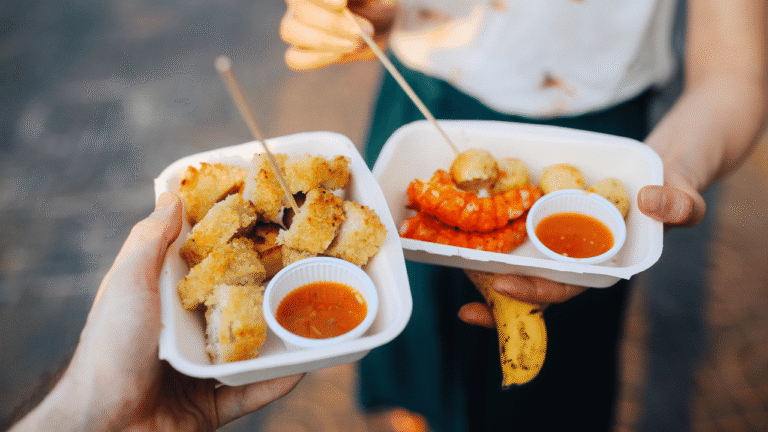
In a lot of the world, street food is not the cheap option, it is the good option. Tacos in Mexico, banh mi in Vietnam, kebabs in Turkey, satay in Indonesia. This is where locals eat, the flavours are honest, and the prices are tiny.
Use a simple safety rule. Choose stalls that are busy, where the turnover is high and the food is cooked fresh in front of you. A queue of locals is the best review you will find.
Street food safety rule
Choose stalls that are busy, where turnover is high and the food is cooked fresh in front of you. A queue of locals is the best review you will find.
Learn to spot the tourist traps
There are clear warning signs that a place is built to overcharge visitors.
- Photo menus with pictures of every dish.
- Staff standing outside waving you in.
- A prime spot right next to a major landmark.
- Menus in six languages with no local prices.
None of these guarantee bad food, but they usually mean higher prices and lower quality. Walk five or ten minutes away from the sight and prices drop while quality climbs.
Picnic on the good days
Some of my favourite travel meals cost almost nothing. A loaf of bread, some local cheese and fruit, a bottle of water, eaten in a park or on a river bank or with a view. It is cheap, it is relaxed, and it is a nicer way to spend an hour than being squeezed into a busy restaurant.
Pack a small foldable bag and a pocket knife where allowed, and you are set for spontaneous picnics.
Drink smart
Drinks are a hidden budget killer. A soft drink or beer with every meal adds up quickly, and cocktails in tourist bars are pricey everywhere.
- Carry a refillable water bottle where the tap water is safe.
- Order the house wine in wine countries, since it is usually cheap and perfectly good.
- Buy drinks from a shop rather than a bar when you just want a beer on your balcony.
Use a few simple tools
A little tech makes eating cheaply even easier. Map apps let you filter for highly rated places away from the tourist strips, and reading recent reviews helps you spot where locals actually eat rather than where tour groups are herded. Translation apps are handy for reading menus and market signs, so you know what you are buying and can order with confidence.
It also helps to learn a few food words in the local language. Knowing the names of common cheap dishes, the word for market, and how to ask for the set menu opens doors that an English only menu keeps shut. Locals warm to visitors who make the effort, and you often end up pointed toward the good, cheap spots. Loyalty and delivery apps sometimes run deals for first time users too, though watch that delivery fees do not cancel out the saving.
Finally, do not underestimate the humble supermarket. Picking up breakfast items, snacks, water and drinks from a local shop rather than cafes and kiosks is one of the simplest ways to keep your daily food spend low without missing out on anything.
A simple daily food plan
Here is the pattern that keeps me eating well for less.
- Breakfast: made yourself or from a bakery.
- Lunch: the set menu or street food, your main meal.
- Dinner: light, from a market or a simple local spot.
- Snacks: fruit and market bits rather than convenience store impulse buys.
Follow that loosely and your food budget stops being the thing that wrecks the trip. You end up eating the food the place is actually known for, spending less, and skipping the bland overpriced meals that tourists settle for. That is a better trip on every level.
| Meal | Cheap approach | Rough cost |
|---|---|---|
| Breakfast | Made yourself or from a bakery | Very low |
| Lunch | The set menu or street food, your main meal | Low, best value of the day |
| Dinner | Light, from a market or simple local spot | Low |
| Snacks | Fruit and market bits, not convenience stores | Minimal |